
Open-Source Language Models and the Future of Regional Knowledge
Compact, locally hosted translation and archival tools are helping universities and civic institutions preserve multilingual heritage.

When large artificial intelligence models first captured public attention, they appeared to require billion-dollar data centers owned by a handful of technology conglomerates. That concentration raised an urgent question for universities, public libraries, medical researchers, and regional institutions across the world: would linguistic and scientific intelligence be controlled exclusively by a few proprietary cloud APIs trained predominantly on English internet text?
Over the past two years, the rapid maturation of open-weights and compact language models has opened a very different path. By combining algorithmic distillation, quantization, and targeted domain fine-tuning, researchers have shown that models small enough to run privately on a single university workstation or municipal server can achieve remarkable accuracy in translation, optical character recognition, and archival indexing.
"The most valuable computational tools do not replace human scholarship; they clear away thousands of hours of clerical drudgery so researchers can think more deeply."
Unlocking Non-Latin Script Archives and Regional Dialects
Throughout South Asia, the Middle East, Southeast Asia, and Africa, millions of pages of historical land records, literary periodicals, botanical treatises, and municipal proceedings sit in library vaults in Bengali, Arabic, Persian, Tamil, Swahili, and Amharic scripts. Because legacy optical-character-recognition software was built primarily for clean Latin typefaces, digitizing and searching these archives required decades of manual transcription.
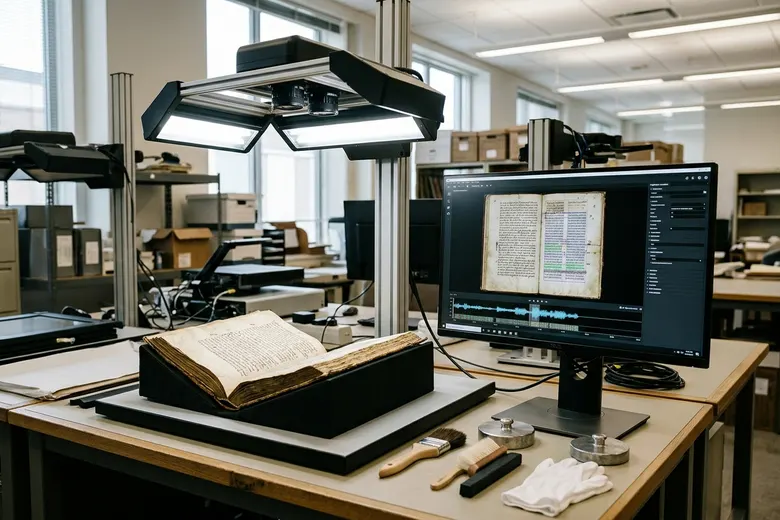
Today, open-source vision-language models fine-tuned by local computational linguists can accurately transcribe aged, faded manuscripts and nineteenth-century regional newspapers into searchable text while preserving original footnotes and citations. A historian or legal scholar can query fifty years of municipal water records or literary journals in seconds.
Privacy and Sovereignty in Public-Sector Computing
Running compact models on local institutional hardware also solves a critical governance problem: data confidentiality. A teaching hospital analyzing patient epidemiology, a legal-aid clinic reviewing court files, or a national archive cataloging sensitive historical manuscripts cannot responsibly upload confidential records to an external commercial cloud server.
Local-first open models allow public institutions to audit the training weights, eliminate external per-token subscription fees, and guarantee that citizen data never leaves the building.
Every technological system encodes choices about who holds accountability, how errors are corrected, and whether human operators remain in command. Engineers who build safety-critical infrastructure—from aviation controls to electrical grids and medical diagnostics—understand that automation works best when it augments human expertise rather than obscuring it behind opaque black boxes. Reliability, inspectability, and graceful failure modes matter far more in practice than marketing demonstrations.
Building Linguistic Pluralism Into the Digital Future
Ensuring that the next generation of computing serves all of humanity requires sustained investment in open multilingual datasets curated by native speakers, linguists, and historians.
When communities control their own computational tools, technology becomes an ally of cultural memory rather than an engine of homogenization.
As software and automated decision systems become embedded deeper into civic and industrial life, technical literacy must be paired with institutional wisdom. Open standards, independent security audits, right-to-repair protections, and clear lines of human liability ensure that tools serve the public interest rather than concentrating unaccountable power. True technological progress is measured by how tangibly it elevates human capability and dignity.
The tools we build ultimately reflect the values we choose to honor. When engineers, civic leaders, and everyday users insist on transparency, repairability, and clear human accountability, technology returns to its proper role as a faithful servant of human flourishing rather than an inscrutable master.
In conversations with practitioners, archivists, and local residents across multiple regions, one observation recurs with striking consistency: durable progress is never achieved by shortcutting foundational maintenance. Whether in civic administration, scholarly inquiry, or community stewardship, the discipline of attending to small realities over decades is what separates thriving institutions from brittle ones. When we honor that patient craft, we build a future worthy of our shared inheritance.
In conversations with field researchers, archivists, and local practitioners across multiple regions, one observation recurs with striking consistency: durable progress is never achieved by shortcutting foundational stewardship. Whether in civic administration, scholarly inquiry, or cultural preservation, the discipline of attending to lived realities over decades is what separates thriving institutions from brittle ones.
More in Technology

The Apprenticeships Returning Craft to Technical Universities
Engineering faculties are pairing theoretical coursework with machine-shop residencies and field maintenance.

Local-First Software and the Movement for Digital Ownership
Why engineers, archivists, and writers are returning to tools that store files directly on the user's machine.

Analog Studios in a Streaming World: Why Musicians Return to Tape
The productive constraints of magnetic tape and live room acoustics are shaping a warmer, more collaborative sound.