
What should a classroom prepare us for?
Teachers, students, and the enduring possibilities of an education that reaches far beyond the examination hall.

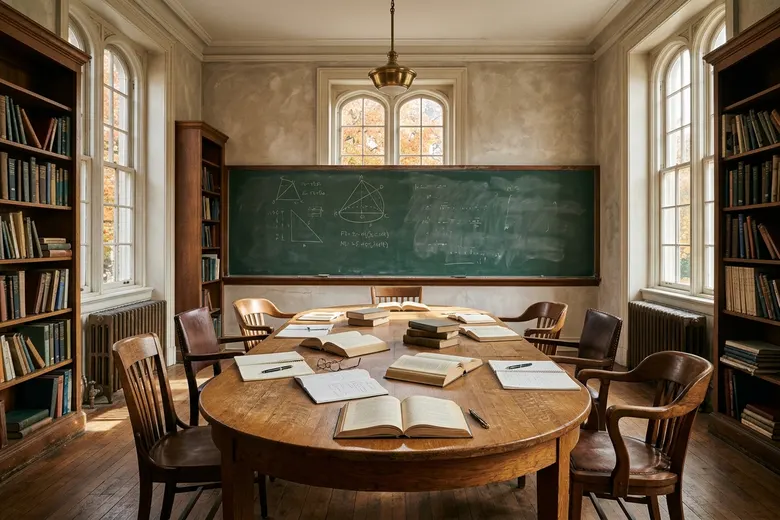
Ask a room of veteran secondary school teachers or university lecturers when they feel most alive in their vocation, and almost none will point to a standardized testing rubric or an administrative compliance audit. They will speak instead of the unscripted fifteen minutes when a history seminar suddenly catches fire, when a shy student defends an original interpretation of a poem, or when a failed chemistry experiment prompts an entire class to reason through the underlying principles together.
Over the past quarter-century, educational policy across much of the globe has been narrowed by an utilitarian anxiety. Schools and universities are increasingly evaluated as mere assembly lines for immediate labor-market credentialing. While technical competence, numeracy, and professional readiness are undeniably important, a curriculum stripped of intellectual curiosity, historical depth, and moral reflection leaves graduates ill-prepared for a world where specific job descriptions change every five years.
"An education worthy of the name does not merely train students to supply memorized answers to predictable prompts; it teaches them how to examine the premises of the question itself."
The Limits of Purely Instrumental Schooling
When schooling is reduced to a high-stakes race for examination scores, both students and teachers are pushed toward defensive habits. Rote memorization of coaching-center templates crowds out genuine comprehension; subjects like history, literature, ethics, music, and studio art are treated as expendable luxuries; and curiosity is replaced by a fear of making mistakes. The irony is that this narrow exam-centric model fails even on its own economic terms.
In an economy reshaped by automation and rapid technological turnover, routine recall and formulaic problem-solving are precisely the tasks machines perform most easily. The capacities that remain distinctively human—synthesizing ideas across disciplines, evaluating the credibility of conflicting sources, writing with clarity and persuasion, and exercising ethical judgment under uncertainty—cannot be crammed in a two-week test-prep bootcamp. They grow slowly through years of wide reading, open debate, and patient mentorship.
Reclaiming the Seminar Table and the Laboratory
Where schools have had the courage to protect time for whole-book reading, Socratic dialogue, and hands-on scientific inquiry, the results are transformative. A student who has wrestled with primary historical documents learns that every archive has a perspective and that complex social events rarely have a single simple cause. A student who builds a working mechanical device or conducts a field ecology survey learns the humility of testing hypotheses against physical reality.
Equally vital is the dignity of the teacher. No curriculum reform or classroom tablet can substitute for a well-read, respected educator who knows their students by name and has the professional autonomy to adapt lessons to the needs of the room. Societies that treat teaching as a high-trust intellectual profession consistently outperform those that bury educators under clerical paperwork.
Inside classrooms and lecture halls, every teacher knows that genuine intellectual formation cannot be reduced to standardized rubric scores or algorithmic modules. Learning is fundamentally a relational human encounter—built on curiosity, patient mentorship, and the willingness to wrestle with complex texts and unfamiliar problems. When educational institutions prioritize administrative compliance over classroom autonomy, both teachers and students lose the space required for deep critical inquiry.
Educating for Citizenship and Inner Resourcefulness
Ultimately, a classroom prepares young people not only for their first job at age twenty-two, but for the fifty years of adult life that follow—as citizens weighing public arguments, as parents guiding the next generation, and as individuals confronting moments of triumph, doubt, and change.
When we give students the tools to read deeply, reason independently, and listen charitably to perspectives different from their own, we equip them with an inner compass that no shifting syllabus or market cycle can render obsolete.
Rebuilding educational excellence requires investing directly in the human core of the school: well-stocked libraries, rigorous foundational curricula in literacy and mathematics, hands-on laboratory and vocational workshops, and respected educators who are given the time to mentor individual students. The true measure of an education system is not the volume of credentials it issues, but the independence of mind and civic character its graduates carry into adulthood.
More in Education
Grassroots Cricket Academies and the Economics of Local Talent
From district maidans to regional tape-ball leagues, how community coaching networks discover tomorrow's pacers.
The Apprenticeships Returning Craft to Technical Universities
Engineering faculties are pairing theoretical coursework with machine-shop residencies and field maintenance.
The Long Tail of Industrial Policy: Lessons from Three Continents
Capital subsidies can build factory shells in two years, but sustaining innovation requires vocational institutes and local suppliers.